For those of you who are interested in seeing the US complete the change to the International System of Units, there is a place where you can make your voice heard.
It seems that our new president-elect will be creating a new position in his cabinet for Chief Technology Officer. There is a website where you can either create or vote on existing topics, thinks the new CTO should address. One of the topics already created is one to complete metrication. It is one of the top topics.
Go to the site and give your votes towards America completing metrication. You can even leave a comment:
http://ideas.obamacto.org/
A metric America
Ametrica,
We have visited this issue here before (I know, you were a prolific poster), and I think the common feeling is that as long as race directors want their intervals marked in miles, we will grant their wish.
We could certainly strongly-encourage all to not use feet in any of our paperwork submissions, and I think that is practical. Applications for certification can easily be done metrically. But, you will still have elevation notations (on some maps) that will be expressed as "feet above sea-level", and mile splits marked, as that is what American runners, as a whole, desire. Until our schools produce a generation that embraces metrics, we will produce non-metric maps. We need to deliver what our clients want, unless it is illegal or does not follow procedures.
I think you missed the whole point. The point is to lend your support to the federal government through the soon to be created office of CTO to complete the metrication of the country. Something that should have been done along time ago.
The first step would be for Congress to do its duty and establish the metric system as the only legal system under the Constitution. They have the right to do so. It means following in the footsteps of countries like Australia that metricated through a complete and thorough plan.
If illiterate street vendors in India could adopt to the metric units in a matter of hours when India metricated, it doesn't say much for the intelligence of supposedly educated Americans if it takes a whole generation to complete the change.
Under a planned conversion the change usually takes place over a ten year period. The economy is divided into sectors and each sector plans their own conversion. Lame excuses like "granny is too old to learn something new" just won't be tolerated.
Now if you are someone who is stuck in the past and don't want to see the country progress, then don't go to the website and vote for the new CTO to tackle the job of metrication. But if you feel as I do that metrication is an absolute necessity for the future prosperity of this country then go there and vote.
Ametrica: Why does the Government, with all its expensive baggage, have to get involved with the switch to the use of this simpler system that is in use throughout the world? Is there not sufficient financial advantage for the "market" to drive the change?
Well, if they do, everyone who suspected Obama of being a subversive will have all doubt removed 
quote:Originally posted by Guido Brothers:
Ametrica: Why does the Government, with all its expensive baggage, have to get involved with the switch to the use of this simpler system that is in use throughout the world? Is there not sufficient financial advantage for the "market" to drive the change?
Because simply it is the right and duty of the government to do so. If you understood what is the government's rights and duties under the Constitution then you wouldn't have needed to ask.
Article 1, section 8 states:
Section. 8. The Congress shall have Power........
To coin Money, regulate the Value thereof, and of foreign Coin, and fix the Standard of Weights and Measures.
So far the government has not established a system of weights and measures for the United states. They have so far given the metric system (SI) complete legal and preferred status. It is time they did their duty by establishing the metric system as the only legal standard (as all other countries have done) and take the steps necessary to establish the metric system as the sole system throughout the entire US economy.
No other country was able to metricate completely and efficiently without government involvement.
The failure of the United states so far to adopt the metric system is a contributing factor in the decline of the American economy and the American living standard.
I think most of the country has or should have learned a valuable lesson from the recent and continuing collapse of the American economy. That is, if you take government completely out and leave everything to market forces you end up with every thief, crook, cheat and liar running the show and doing everything in their power to defraud every investor and every honest worker out of his/her life savings.
The constant Republican rhetoric about keeping government out of people's business has shown itself for what it is worth. We need government involvement to keep the market honest and we need government involvement to coordinate the market as it switches to metric. Without a coordinated effort you will have a mish-mosh of measurement confusion and rip-offs.
quote:Originally posted by Jim Gerweck:
Well, if they do, everyone who suspected Obama of being a subversive will have all doubt removed
One thing we can say about Obama is he will be the best educated president the US has had in a long time. He didn't beat the odds by being stupid.
And to those who have "suspected" Obama to be a subversive, then nothing Obama will ever do will ever change their minds, so Obama has nothing to lose by doing something that may seem unpopular to the ignorant but is in the best interest of the nation in the long term.
The only real subversives in this country are those who since the Reagan times have insisted on less government and used the opportunity of less government to cheat, lie, and swindle the American middle class out of decent paying jobs, benefits and their savings.
It may be that those who suspected may now have to worry because it just might be that when Obama is in heads will roll and it won't take a rocket scientist to guess whose heads those will be.
Will yours be one of them?
Back off on the politics, guys.
As moderator I may be forced to use my unilateral and dictatorial powers.
As moderator I may be forced to use my unilateral and dictatorial powers.
I thought we were heading down the road to socialism, not a dictatorship.
Ametrica, about the only way I would support government involvement in a transition to the metric system would be to convert the military to metric. That way, all contractors would have to build machinery and weapons using metric specs; all military personnel would get immersed in the system and would likely use it after ending their service; and the military could even change the GPS satellites to only report distances metrically.
I think that would be a huge motivator for the rest of the country to change to metrics, as any contractor supplying the military, either directly or indirectly, would likely shift all commerce to metric, for financial reasons. Then, more of us civilians would have to adopt metrics when dealing with those suppliers, and it would work its way into our daily lives. No need for government to spend billions forcing it down our throats. The market would take care of it.
As far as your idea that a market system leads to pervasive corruption, I would put our pastime up as an example that crooks, liars, and cheats are not pervasive in every, or even most, market environments. We have guidelines for our measuring, but it is up to each of us to work efficiently, set our own prices, and service clients as we see fit. I don't see anyone twisting arms for personal gain, or collusion for setting prices, or any other nasty situation that you say is inevitable in the open market. I would you suggest you step back, and look at the market environment with a positive attitude, instead of a conspiracy bent. Life is much more enjoyable when you are not suspecting everyone of malfeasance. (I hope this is not too political, Pete. I intend it more as a "look at life more as a glass half-full" comment.)
Duane, that's pretty much done. Weapons are metric (55mm howitzer, rounds for M-16 were designated as 7.62mm to allow interchangeability w/ NATO allies, and I know the artillery guys range their guns and the infantry reports distances in kilometers ["klicks"]).
And just to add a devilish note, next week I'm putting on a holiday race called the "Christmas T(h)ree Miler." While Ametrica and Bob Baumel would probably disagree, somehow I don't think it would come off well as the "Christmas 4.828K."
And just to add a devilish note, next week I'm putting on a holiday race called the "Christmas T(h)ree Miler." While Ametrica and Bob Baumel would probably disagree, somehow I don't think it would come off well as the "Christmas 4.828K."
After reading the news the last two days, I can certainly testify that a free-market system leads to corruption.
It certainly sounds like we were in the middle of a free-market auction for our open Senate seat.
And the guy orchestrating it was standing at a closed factory the day before his arrest, "standing up for the little guy"...
It certainly sounds like we were in the middle of a free-market auction for our open Senate seat.
And the guy orchestrating it was standing at a closed factory the day before his arrest, "standing up for the little guy"...
Jay, I'm glad to see IL regain its rightful place along w/ NY as the most corrupt political state in the Union (CT & NJ make a nice Tri-State scandal trifecta).
The question is, which governor was worse - the one screwing the call girl, or the one screwing his constituents?
The question is, which governor was worse - the one screwing the call girl, or the one screwing his constituents?
Jim,
I knew weapons were metric, but how about clothing, vehicles, cots, tents, etc. That is the pervasiveness I am looking for. I think having everything in the military metric would guide the country better than an edict to the masses from our politicians. Politicians can't seem to try to solve anything without a bailout lately. The market would work, if people would let it.
(Are there abuses of the system? Yes, but every profession, whether it is free-market, government, or religious has its bad apples. Don't for an instant say the system is bad, when it is a very few players that abuse the system! Socialists and Communists have their abusers, also.)
quote:Originally posted by Duane Russell:
I thought we were heading down the road to socialism, not a dictatorship.
Ametrica, about the only way I would support government involvement in a transition to the metric system would be to convert the military to metric.
Well, then I'm glad we have your support, because the military is already fully metric. I'm surprised you didn't know that.
quote:That way, all contractors would have to build machinery and weapons using metric specs; all military personnel would get immersed in the system and would likely use it after ending their service; and the military could even change the GPS satellites to only report distances metrically.
They already do. The GPS is metric too, as the data that is communicated back and forth is metric. Maybe you receiver communicates to you in dinosaur units. That is because your receiver translates everything when you set it to default to dinosaur units. It also means the data is inaccurate due to rounding errors.
quote:I think that would be a huge motivator for the rest of the country to change to metrics, as any contractor supplying the military, either directly or indirectly, would likely shift all commerce to metric, for financial reasons. Then, more of us civilians would have to adopt metrics when dealing with those suppliers, and it would work its way into our daily lives. No need for government to spend billions forcing it down our throats. The market would take care of it.
What do you mean by "metrics"? The measurement system is in the singular, metric, no s at the end. Metrics is something totally different. It is a type of statistical analysis.
Many businesses do operate in the metric system but don't inform the outside world. Do you know there are still people who think cars built on US soil use dinosaur units even though American car companies have been metric since the '70s? Think of every company that supplies them and the foreign companies, they are metric too. It is estimated that about 60 % of US industry operates in metric.
In some cases where workers didn't want it forced down their throats, the companies simply closed, put the resistant workers on the street and moved the production to metric countries. There are many effective ways to circumvent troublemakers.
quote:As far as your idea that a market system leads to pervasive corruption, I would put our pastime up as an example that crooks, liars, and cheats are not pervasive in every, or even most, market environments. We have guidelines for our measuring, but it is up to each of us to work efficiently, set our own prices, and service clients as we see fit. I don't see anyone twisting arms for personal gain, or collusion for setting prices, or any other nasty situation that you say is inevitable in the open market. I would you suggest you step back, and look at the market environment with a positive attitude, instead of a conspiracy bent. Life is much more enjoyable when you are not suspecting everyone of malfeasance. (I hope this is not too political, Pete. I intend it more as a "look at life more as a glass half-full" comment.)
I did look at the market with a positive attitude until the past year began to expose the truth on how it operates and I, like millions of others, no longer trust it.
quote:Originally posted by Jim Gerweck:
Duane, that's pretty much done. Weapons are metric (55mm howitzer, rounds for M-16 were designated as 7.62mm to allow interchangeability w/ NATO allies, and I know the artillery guys range their guns and the infantry reports distances in kilometers ["klicks"]).
And just to add a devilish note, next week I'm putting on a holiday race called the "Christmas T(h)ree Miler." While Ametrica and Bob Baumel would probably disagree, somehow I don't think it would come off well as the "Christmas 4.828K."
You could just as well have a Christmas T(h)ree kilometre and be standardized, or have a Christmas 5 km race as these tend to be popular. You can even call it a 3 miler as miles aren't really accurate and nobody would know the difference.
Doing a non-metric event just means no official recognition and no way to compare with those who do it correct.
The pharmasudical industry is not metric. They say it's a matter of scruples, but no one seems to give a dram.
Mark, don't you have some work to do???
Mark,
I can't fathom the reason. It goes against the grain and is a knotty problem.
I can't fathom the reason. It goes against the grain and is a knotty problem.
quote:Originally posted by Pete Riegel:
Mark,
I can't fathom the reason. It goes against the grain and is a knotty problem.
I'm surprised to see that this thread has become so popular. It really wasn't suppose to turn into a discussion. The whole point of the post was to point out the web site for Obama's CTO and for posters to this site to go there and vote for metrication.
So if you haven't done so yet, now is just as good as any to go there and cast your vote in favour of metrication:
http://ideas.obamacto.org/
We've had secondary metric signage on everything from highways to soda cans for years. By now everyone knows a pound is 454 grams and there's 355 ml in a 12-oz can. Celsius conversion still eludes most of us.
But popular opinion is that there's no impetus for abandoning the units we grew up with, other than helping visiting Canadians avoid confusion.
I'm sure Britain endured a similar debate when they decimalized their currency. But they still haven't fully adopted the metric system.
You can probably put it all down to stubbornness. Americans as a whole don't like being told what to do, especially by pointy-headed academics who think they know better just because they're educated.
We've been metricizing since the 70's. It hasn't caught on. The overnight approach is probably best. Just announce that we're going metric as of midnight. But our fearless leaders ain't that fearless.
Would all the roads around Detroit (Eight Mile, Twelve Mile, etc) have to be re-named as well?
Would all the roads around Detroit (Eight Mile, Twelve Mile, etc) have to be re-named as well?
Actually, they might do that if we went completely metric. Many of those Mile roads change their name at the county line. 15-Mile becomes Maple, 16-mile becomes Big Beaver (which, by the way, is exit 69 off of I-75, but now I'm getting way off topic and dangerously close to having my post deleted so I'll stop).
Actually, they might do that if we went completely metric. Many of those Mile roads change their name at the county line. 15-Mile becomes Maple, 16-mile becomes Big Beaver (which, by the way, is exit 69 off of I-75, but now I'm getting way off topic and dangerously close to having my post deleted so I'll stop).
And the music industry. The Byrds' old hit would have to become have to be "12.874 Kilometers High." And would the great jazz trumpeter have his name changed posthumously to "1.6km Davis?"
I'll say one thing for metric measurement: it makes the distance-to-time conversion real easy, especially if your truck is governed at 61 mph.
300 kilometers to go = 3 hours. Easy as.
300 kilometers to go = 3 hours. Easy as.
quote:Originally posted by Mark Neal:
Would all the roads around Detroit (Eight Mile, Twelve Mile, etc) have to be re-named as well?
Actually, they might do that if we went completely metric. Many of those Mile roads change their name at the county line. 15-Mile becomes Maple, 16-mile becomes Big Beaver (which, by the way, is exit 69 off of I-75, but now I'm getting way off topic and dangerously close to having my post deleted so I'll stop).
Metrication has nothing to do with the renaming of roads, so why would anyone even suggest it? It is only involved with actual measurement. But if it does bother some people and there is enough support to change the names, then they can simply rename the streets to names other cities have. 8 mile would become North 8-th Street, 13 mile would become North 13-th Street etc.
Does anyone know why there are no mile named streets in any of the other directions around Detroit, just north of the city?
Another interesting note on the subject is that in some countries, a business may include a kilometre distance along a road (as measured from the centre of town) as part of its address. I believe in Mexico this practice is common.
For example your business may be located on South Main Street km 27.
quote:Originally posted by Jim Gerweck:
And the music industry. The Byrds' old hit would have to become have to be "12.874 Kilometers High." And would the great jazz trumpeter have his name changed posthumously to "1.6 km Davis?"
You can always spot an anti-metric person. They become so obsessed with converting non-real rounded non-metric measurements into overly exact metric values without any concern for the accuracy of the original value.
Jim, were you playing hooky from math or science class when they taught the meaning of significant digits?
Obviously you are stating the original distance in the song was 8 miles and used the 1.609344 conversion factor to come up with 12.874 752 km. Obviously you just truncated the number to an accuracy of 1 m, but you did it wrong. It should have been rounded up to 12.875 km.
But still the true number would be 13 km as 13 would contain the same degree of significant digits as the 8 mile figure.
Here is where Jim's attempt to mock metric with over precise conversions can back fire. The true length of the Marathon is an exact 42.195 km. Converting this to miles using the 1.609 344 conversion factor results in a figure of 26.218 757 456 454 306 848 007 635 409 21 miles. I'll leave it as an exercise for Jim to convert this figure to yards, feet, inches and whatever and for Jim to prove that the complex 26 mile blah blah blah yards is wrong and what the difference is between the true value and the rounded, accepted value.
An interesting fact is that the incoherency of non-metric units creates extreme difficulty in working with numbers that are not round. Thus there is an aversion to non-rounded numbers in non-metric usage. Metric units however have no problem handling non-rounded numbers. 12.875 km can be easily made into a rounded number of metres simply by moving the decimal point so the number becomes 12 875 m. You can't do this in non-metric units. Thus non-metric units are inferior to metric units and the structure of the international system.
Also note how the metric world has no problem dealing with the marathon as 42.195 km and there is no need or desire to round it to either 42.2 km or even 40 km or 50 km.
But don't the road race rules by the IAAA require that all splits be timed in rounded metric distances (such as every 10 km) and no timing for miles is supported? I believe previously I posted the rule somewhere on the forum.
quote:Originally posted by Stu Riegel:
I'll say one thing for metric measurement: it makes the distance-to-time conversion real easy, especially if your truck is governed at 61 mph.
300 kilometers to go = 3 hours. Easy as.
I believe this has to do with the international standard for timing performance on automobiles to be the number of seconds to achieve a velocity of 100 km/h. Thus when this is converted, it is rounded to anywhere between 60 ~62 mi/h.
Maybe though we need to follow Jim's example and make it precisely 62.137 119 223 733 396 961 743 418 436 332 mi/h. We can leave this as an exercise for Jim to break it down into its other unit components.
quote:Originally posted by Stu Riegel:
We've had secondary metric signage on everything from highways to soda cans for years. By now everyone knows a pound is 454 grams and there's 355 ml in a 12-oz can. Celsius conversion still eludes most of us.
Stu, I don't think anyone really knows what a pound or ounce is. Want to conduct a test? Go to the deli at any local supermarket and ask for something in an amount that is not either 0.25, 0.5, 0.75 or 1 lb. Ask for 10 ounces instead and watch the surprised look you get. They will ask you to translate that into pounds. Then tell them you have a recipe that requires only that amount and that is all you want to buy. You can even tell them that the amount is equal to 300 g. Then they will tell you they don't do metric. After which you tell them they obviously don't do American measures either or they wouldn't have such a difficulty filling the request. The next step is they get the manager. It is even more of a hoot when the manager can't figure it out either.
If you decide to try this test, make sure you keep a serious look the entire time and avoid smiling or laughing.
You don't even need to change degrees Celsius to Fahrenheit. All you need to do is remember that 30°C is hot, 20°C is warm, 10°C is cool and 0 °C is freezing. That is what you really want to know when a temperature is given anyway. Your body temperature is 37°C (98.6 is an exact conversion of the rounded 37°C). The human body can only withstand an exposure to a temperature of 50°C for a few hours before you die of heat stroke. If you need some more references then you can make your own and memorize as many as you need, but for the majority of innumerate people the range from 0 to 30 will suffice.
quote:But popular opinion is that there's no impetus for abandoning the units we grew up with, other than helping visiting Canadians avoid confusion.
That is because most people don't really think about how much a fully functional metric America would improve their living standard by creating better jobs, make simple calculations easier and thus save money when shopping. It would decrease wastage due to measuring errors when using non-metric units. It would also save lives as there are many medical errors resulting in death from miscalculating dosage based on body mass in kilograms. There are a lot of good reasons. But most people are too ignorant to figure it out.
quote:I'm sure Britain endured a similar debate when they decimalized their currency. But they still haven't fully adopted the metric system.
Not true about Britain but very true about the English. The non-English British have adopted metric more extensively then the English. Industry in the UK is fully metric as are the products in the supermarket. There are no dual labels. The deli scales are all in kilograms. But some people let their stupidity overcome them and insist on asking for pounds and ounces. This leaves the counter person free to oversell the products as it is up to the customer to compare what they have asked for versus what they see on the scale.
In reality it is not possible to get an exact pound even if a product is carefully weighed. UK scales only display to the nearest 5 g. Thus for a pound (453.6 g) the closest you can ever get is 455 g. But most shops will weigh out 460~480 g and just say "it's a little over". Only those who are opposed and have memorized the exact conversions may refuse to accept the amount and insist on being given a closer amount.
Petrol (gasoline) is only sold by the litre. There are no gallons.
quote:You can probably put it all down to stubbornness. Americans as a whole don't like being told what to do, especially by pointy-headed academics who think they know better just because they're educated.
I'm sure stubbornness is a human trait everywhere, but when something has long term benefits, ignorance and stubbornness are ignored and the change is made anyway. Then the hardships fall on those who resist. Let it be their punishment that they suffer as a result.
quote:We've been metricizing since the 70's. It hasn't caught on. The overnight approach is probably best. Just announce that we're going metric as of midnight. But our fearless leaders ain't that fearless.
It has caught on where it is important and those that haven't grasped it are usually on the outside looking in. I just wonder how much of this economic depression we are in could have been avoided if the economy was 100 % metric.
quote:Would all the roads around Detroit (Eight Mile, Twelve Mile, etc) have to be re-named as well?
No, why would they need to be? They're just names, not measurements.
We are all in favor of moving to the metric system. It's just that most of us aren't willing to go the extra 1.609347219km to convince others.
I just voted on the site Ametrica recommended. If it's something that means enough for Ametrica to sign up for our site and ask for our help, why not do it? What the hell. I figure a vote's a vote, regardless of motivation.
I think the problem for most advocates for a cause is not outright opposition, but indifference.
I think the problem for most advocates for a cause is not outright opposition, but indifference.
quote:Originally posted by Mark Neal:
We are all in favor of moving to the metric system. It's just that most of us aren't willing to go the extra 1.609347219km to convince others.
I was wondering where you came up with that definition of the mile. Then I realized it came from the definition that was in effect from 1900 to 1960, when the yard was defined as 3600/3937 m. But in 1960, the yard was officially redefined to be exactly 0.9144 m. This makes the definition of the mile presently to be 1.609 344 km. The previous definition of the mile is thus 3.219 mm longer then the present. Does anyone know what the definition of the mile was before 1900?
Even though it is not official, doesn't track & field events usually refer to 1500 m or 1600 m as a mile? So between the 1900 definition, the 1960 definition, the 1852 m definition of the nautical mile, the track and field unofficial definition, we presently have 5 versions of the mile. The metre and thus the kilometre have never changed and thus there is only one version.
Isn't your statement somewhat contrary to what America is all about? Aren't Americans suppose to be better then everyone else and always willing to strive for what is the best? Your comment and others I have heard similar seem to allude that Americans aren't willing to strive for the best.
You actually don't need to go that far if the effort is too great. Just go the extra 100 m. At least with metric you can easily tailor the distance you are able or willing to go.
"...cause is not outright opposition, but indifference."
Pete, who cares???
Ametrica, with all due respect, lighten up! The comments about the Byrds' song, and street names were light-hearted humor, not a serious concern about street names, etc. I know it isn't the same as British humor, but I got a chuckle out of the comments.
Regarding Ametrica's topic, as measurers, are we willing to start suggesting to race directors that we only mark km distances? If the race publicizes that marking, and runners in our areas become accustomed to it, races may become metrically-marked. That would be an inroad to metricization of some people, possibly. How much resistance do we think we may get from race directors, and then runners?
Thanks Duane. Ametrica, you mistook my attempt at humor as opposition; in fact I'm a huge advocate of metricization as the way to go. I even produce several races in which we only mark kilometer splits rather than miles, as a type of "forced education" of runners.
quote:Originally posted by Jim Gerweck:
Thanks Duane. Ametrica, you mistook my attempt at humor as opposition; in fact I'm a huge advocate of metricization as the way to go. I even produce several races in which we only mark kilometer splits rather than miles, as a type of "forced education" of runners.
Sorry Jim, but I don't always sense when someone is trying to be funny, especially when it a appears to be mocking. Problem is I've seen this type of mockery made by serious opponents as a way to make the metric system look bad and frighten away potential supporters.
What would you think if your exposure to the metric system was zero and someone came along and tried to convince you your life would be a living hell if it was adopted? They would use examples like distances in your life that you are familiar with. Suppose you knew that your local commercial district was about 4 miles from your home (not exactly but close enough for a reference). Now some opponent comes along and tells you that if we ever went metric, that 4 miles would become 6.437 376 km. Here a simple single digit number which isn't exact anyway would become a 7 digit number. You too would become an opponent too. Who wouldn't?
Now someone like me comes along to express the benefits of the metric system and you tell me you are opposed because metric numbers are long and ridiculous. Of course I could try to explain that the 4 miles is only an approximation and the metric approximation would be 6 km. You may believe me or the other person depending on what or who you want to believe.
Such humour makes it harder to convince some people to make an effort to change.
What I do find interesting is that opponents become highly incensed when the non-metric units are attacked by pointing out how they are not exact, mean different things to different groups of people, change value at a whim, etc. All of which is true.
My point is, if you are going to express a non-metric value in metric, take care to convert it properly, taking into account the correct number of significant digits and to assure the the metric value is to no greater accuracy then the non-metric value.
quote:I even produce several races in which we only mark kilometer splits rather than miles, as a type of "forced education" of runners.
Jim, I still don't understand why all races are not marked in kilometres, only some as you have stated. Isn't that what the rules state?
See:
http://www.bcathletics.org/main/rr_iaaf.htm
Rule 240-4 states:
4. The distance in kilometres on the route shall be displayed to all athletes.
The way it reads, is that kilometres is not an option but a requirement.
Of course there is no rule stating miles can't be added, but it seems the rule is quite clear that distances in kilometres are required. So how can it be circumvented?
Maybe some race promoter may have an issue with distances shown in kilometres and may find having both miles and kilometres a nuisance, but if he wants his course legally certified then he has no choice but to follow the rules. Don't you agree?
Isn't there also a rule at to when times should be measured? For marathon races aren't they at each 10 km? I don't remember.
If Jim doesn't know, does someone else?
Ametrica, we are not saying that American courses with international world-class competitors shouldn't be marked at the kilometers.
You brought up the IAAF rules, which pertain to international races and records. The rule that you site also states "standard distances". The majority of races that we measure seem to be 5k, so they are not considered a standard distance, thus falling outside the guidelines of IAAF. Not to mention that most of the 5k races don't have world-class competitors.
We can try to gradually change race markings to kilometers, but the race directors must approve of that, as they are the client. Unless the RD feels they will have a record set on their course, the race is more for raising money for their cause. Well-produced races will attract better runners from the community, and possibly from surrounding areas, but there is still very little chance of an American record being set, let alone a world record.
Invoking the IAAF rules for most races in the U.S. is next to pointless. That is similar to requiring a new programmer to follow all ICAAN standards when they write their first "Hello, world" program, including documentation, etc. Not practical, and not necessary for the type of project being produced.
An accurate 5k course is all that most directors want. However, it does seem somewhat ironic that they want a 5k course, with only miles marked. Silly Americans! But, then again, many Americans voted for "change", when "change" was never defined. Go figure! Maybe this would be a good time to introduce Obametrication to the U.S., and achieve the goal you, Ametrica, want.
Duane, you're right, it's ironic RDs want their course marked in miles, yet how many times have you seen a perfectly good natural 3 mile course ruined by adding the distance to make it 5K "because more people will run my race if it's 5K"?
Seems they want to have their metric cake but not eat it too.
Seems they want to have their metric cake but not eat it too.
Would that be their .45 kg cake?
quote:SHYLOCK: The 0.45 kilogram of flesh which I demand of him Is deerely bought, 'tis mine, and I will haue it.
We use Imperial units because we always have, except for the gallon and its derivatives of which we have our own.
Perhaps it is the US Gallon that's behind our stubbornness. That unit is uniquely American, and therefore superior to any one-world unit of measure. Adopting the metric system would be to abandon our cultural heritage and everything we hold dear.
Also, adopting the metric system would lend credence to the tinfoil-hat crowd, who worry that America is under attack from The Globalist Conspiracy. After all, invading UN troops could easily read metric signs, and our women wouldn't be safe in their beds. And those UN troop all use that funny foreign ammunition marked in millimeters. Nothing could be worse than being shot with a foreign metric bullet.
All kidding aside (and the above was kidding (although the bit about the gallon may have some credence)) we're all on your side, because we're familiar with metric measurement. The majority of Americans, however, are still not.
The only way to metricize America is to get a lame-duck President to sign an executive order authorizing it. He won't have to worry about getting re-elected. His legacy in the short term will be one of outrage, but in the long term we'd thank him for doing it.
quote:Originally posted by Duane Russell:
Would that be their .45 kg cake?
Duane,
Metrication will not change the name of the pound cake. But it may change the actual size.
According to Wikipedia:
http://en.wikipedia.org/wiki/Pound_cake
A traditional American pound cake would contain one pound each of flour, butter, eggs, and sugar. Since the amounts are all equal, they really can be any amount. If you check the Dutch (Nederlands) Wikipedia article, you will see the amount of each ingredient is 200 g.
IN countries that have metricated there are still some who use some old unit names like pound, but they are all redefined to rounded numbers. Thus a pound is 500 g.
If you go to the market and ask for a pound, livre, punt, pund, pfund, libra, jin, etc of something, you will have 500 g measured out for you on a completely metric scale.
So if you make a pound cake anywhere in the world, it will have a mass of 2 kg, if each of the 4 ingredients is 500 g each.
I wonder how an American cook would measure out an American version of the pound if American cooks don't use balances. They use only cups and spoons. Everywhere else cooks use balances, as cooking is treated like chemistry and balance only happens correctly when dealing strictly with masses.
BTW... You forgot to place a zero to the left of the decimal point. Nekkid decimals is a no-no. 0.45 kg is correct. If you want to avoid the rule, then simply reduced the expression to 450 g. This type of conversion is easy in metric. I would only suggest trying something similar in USC/Imperial only if you have a strong heart.
quote:Originally posted by Jim Gerweck:
Duane, you're right, it's ironic RDs want their course marked in miles, yet how many times have you seen a perfectly good natural 3 mile course ruined by adding the distance to make it 5K "because more people will run my race if it's 5K"?
Seems they want to have their metric cake but not eat it too.
What makes 3 mile natural and 5 km not? Obviously it can't be too natural if every one is shying away from it for whatever reason?
Here is where you have the opportunity to persuade the RD to go all the way. A 5 km race should be run with 5 km splits. This is how you make change work, with logic and persistence. Try it! You might surprise yourself!
quote:Originally posted by Stu Riegel:
[QUOTE] SHYLOCK: The 0.45 kilogram of flesh which I demand of him Is deerely bought, 'tis mine, and I will haue it.
quote:We use Imperial units because we always have, except for the gallon and its derivatives of which we have our own.
Stu, if you live in Cleveland OH, then you don't use imperial units. Imperial units came into use about 1824 when the were adopted throughout the British empire. Metrication in the 1960s throughout the empire ended their reign.
What you use instead is what the US government defines as USC (United states Customary units). Imperial and USC are not the same. Most units carry the same name but the the size of the units is different. Only pound weight and the inch (and only since 1960) are the same. All else varies and by large amounts.
quote:Perhaps it is the US Gallon that's behind our stubbornness. That unit is uniquely American, and therefore superior to any one-world unit of measure. Adopting the metric system would be to abandon our cultural heritage and everything we hold dear.
How would it do that? Would rock & roll, blue jeans, apple pie, fourth of July, etc. disappear the moment metric is adopted everywhere? Can you provide an example where this has happened before?
quote:Also, adopting the metric system would lend credence to the tinfoil-hat crowd, who worry that America is under attack from The Globalist Conspiracy. After all, invading UN troops could easily read metric signs, and our women wouldn't be safe in their beds. And those UN troop all use that funny foreign ammunition marked in millimeters. Nothing could be worse than being shot with a foreign metric bullet.
[quote] When the Nazis invaded their neighbour's countries, they ignored the road signs and followed their maps. I would suspect that foreign troops invading the US would use GPS units operating in the metric mode.
I'm sure there are a lot of American women who would drool at the chance of having a foreign soldier sweep them off their feet. Especially if they are French.
If you are shot by a metric bullet, you would not even know it. You'll be dead.
But you don't need to be shot by a foreigner to be shot with a metric bullet. One of your fellow citizens could accomplish the same thing. Have you ever heard of a 9 mm gun? They are the most popular.
[quote]All kidding aside (and the above was kidding (although the bit about the gallon may have some credence)) we're all on your side, because we're familiar with metric measurement. The majority of Americans, however, are still not.
The question is, are they really familiar with USC? I know you were kidding above, and some of my answers may seem like I thought you were serious. But just in case someone thinks it all is fact will see that it really isn't
quote:The only way to metricize America is to get a lame-duck President to sign an executive order authorizing it. He won't have to worry about getting re-elected. His legacy in the short term will be one of outrage, but in the long term we'd thank him for doing it.
When we change to the metric system, we metricate, not metricize. Some will even say metrification instead of the correct metrication. There is no "if" in metrication.
That is your first lesson.
http://dictionary.reference.com/browse/metrication
quote:What makes 3 mile natural and 5 km not? Obviously it can't be too natural if every one is shying away from it for whatever reason?
Well, just a fer instance, a course very near my home starts directly in front of a school, and finishes in the driveway after making a loop of the neighborhood, taking all right turns. To make it 5K, the start would have to be backed up 171.968m down the road, or some cockamamie out & back down a side street added.
Of course, I look at any "natural" distance, metric or USC, somewhat askance, coming from New England, home of non-standard distances (the biggest race in CT is the Manchester Thanksgiving Day race at exactly 4.748 miles. Nobody seems to care that it's a weird distance, but I can assure you holy hell would be raised if it was changed to 5 miles or 8km. There are plenty of others like that, too.)
To quote Tevye in Fiddler on the Roof: "Tradition!"
quote:Originally posted by Ametrica:
Stu, if you live in Cleveland OH, then you don't use imperial units. Imperial units came into use about 1824 when the were adopted throughout the British empire. Metrication in the 1960s throughout the empire ended their reign.
What you use instead is what the US government defines as USC (United states Customary units). Imperial and USC are not the same. Most units carry the same name but the the size of the units is different. Only pound weight and the inch (and only since 1960) are the same. All else varies and by large amounts.
I stand corrected. I've always heard feet and inches referred to as Imperial, but I will defer on this one.
quote:Perhaps it is the US Gallon that's behind our stubbornness. That unit is uniquely American, and therefore superior to any one-world unit of measure. Adopting the metric system would be to abandon our cultural heritage and everything we hold dear.
quote:How would it do that? Would rock & roll, blue jeans, apple pie, fourth of July, etc. disappear the moment metric is adopted everywhere? Can you provide an example where this has happened before?
One thing I can say is that you can't fight ignorance with logic. You can try, but you just get dirty and the pig enjoys it.
quote:
If you are shot by a metric bullet, you would not even know it. You'll be dead.
It's the principle of the thing. No proud American could sleep in his grave knowing he'd been shot with such an abominable thing. I hold that the metric system is behind all the shades walking the earth in agony. Can't you hear them?
quote:But you don't need to be shot by a foreigner to be shot with a metric bullet. One of your fellow citizens could accomplish the same thing. Have you ever heard of a 9 mm gun? They are the most popular.
And 9mm is just a funny foreign way of saying .38 caliber.
.223 and 7.62mm ammunition are the same shells in a different box. (No leading zero here; conforming to established practice).
And that's the phrase right there: Established Practice. Ask 10 people to hold their fingers an inch apart, and 9 of them will be within a sixteenth of the real value.
True story: When I worked retail, I had a customer ask me how long a six-inch cord was. This was an American, mind you, about 50 years of age. I had to show him, as my reply of "uh, six inches?" didn't seem to help. Once we'd established that, he asked about the 12-inch cords. I think I let him take the store's yardstick home to familiarize himself with the suddenly-unfamiliar units of measure.
No, he didn't have a head injury but he was asking for one.
I remember meter sticks from elementary school. The general consensus was that they weren't as good as yardsticks. Although the population sampled (7-year-olds) may have skewed the results.
quote:
The question is, are they really familiar with USC?
The University of Souther California? Sure, we kicked their butt in the 1968 Rose Bowl
quote:
When we change to the metric system, we metricate, not metricize. Some will even say metrification instead of the correct metrication. There is no "if" in metrication.
That is your first lesson.
Gerweck's pharmacist messed up and gave me the wrong metrication. What are these little blue pills anyway?
quote:Here is where you have the opportunity to persuade the RD to go all the way. A 5 km race should be run with 5 km splits. This is how you make change work, with logic and persistence. Try it! You might surprise yourself!
And then when he does it he gets endless complaints from the runners in his race. Most RDs' main goal is to get as few complaints as possible, which generally maximizes the number of runners he gets the following year. Converting the world to the metric system is not very high on his list of objectives. If he does decide to take a principled stance to convert everyone, he will very quickly principle himself and his race into non-existence.
There is no argument on this board about whether the US should convert to the metric system. Of course it should. The only argument is how to go about that. I think we all have more experience than you in dealing with American runners, American RDs, and Americans in general, and we know that condescending logical arguments will not work. Forcing it down their throats will not work. Telling them how stupid they are for still using their old system will not work.
The only way to convince them is to argue that the short-term conversion pain will be worth the long-term benefit. And that is a tough argument. The vast majority of Americans, unlike Europeans, have NO interaction with anybody outside their own country. The vast majority of Americans have a very small set of measurement units that they deal with: miles, yards, feet, inches, degrees, pounds, gallons, cups, tablespoons, teaspoons. That's pretty much it, and they're pretty simple to remember. How many yards in a mile? How many ounces in a pound? How many tablespoons in a quarter cup? They don't know, and they don't care, and for the most part it doesn't affect their lives.
It's a hard sell to convince them that changing to the metric system will make their lives easier.
Mark, I do have to say that most runners who run in my metric-only races agree it's a lot easier to figure out pace in kms rather than miles, once they relax their thinking. That said, none of them seem to ask the next RD to do the same.
quote:Originally posted by Stu Riegel:quote:Originally posted by Ametrica:
Stu, if you live in Cleveland OH, then you don't use imperial units. Imperial units came into use about 1824 when the were adopted throughout the British empire. Metrication in the 1960s throughout the empire ended their reign.
What you use instead is what the US government defines as USC (United states Customary units). Imperial and USC are not the same. Most units carry the same name but the the size of the units is different. Only pound weight and the inch (and only since 1960) are the same. All else varies and by large amounts.
I stand corrected. I've always heard feet and inches referred to as Imperial, but I will defer on this one.
Well, they are imperial as well as USC. Before 1960, the USC foot and inch and other units derived from them were different then the imperial counter-parts. The US defined the yard as 3600/3937 m, and imperial defined the yard 0.9144 m. The American versions were longer then imperial. It was in 1960 that the US agreed to change the definition of the yard to 0.9144 m exactly, thus making all the length units equal to their imperial counterparts.
quote:quote:Perhaps it is the US Gallon that's behind our stubbornness. That unit is uniquely American, and therefore superior to any one-world unit of measure. Adopting the metric system would be to abandon our cultural heritage and everything we hold dear.
quote:How would it do that? Would rock & roll, blue jeans, apple pie, fourth of July, etc. disappear the moment metric is adopted everywhere? Can you provide an example where this has happened before?
One thing I can say is that you can't fight ignorance with logic. You can try, but you just get dirty and the pig enjoys it.
That doesn't mean you should give up. And there is also the possibility the pig is only pretending to enjoy it.
quote:quote:
If you are shot by a metric bullet, you would not even know it. You'll be dead.
It's the principle of the thing. No proud American could sleep in his grave knowing he'd been shot with such an abominable thing. I hold that the metric system is behind all the shades walking the earth in agony. Can't you hear them?
No. Only because there is no such thing. The dead in their grave have no knowledge of the living world.
Ecclesiastes 9:10 and Psalm 146:4
quote:quote:But you don't need to be shot by a foreigner to be shot with a metric bullet. One of your fellow citizens could accomplish the same thing. Have you ever heard of a 9 mm gun? They are the most popular.
And 9mm is just a funny foreign way of saying .38 caliber.
.223 and 7.62mm ammunition are the same shells in a different box. (No leading zero here; conforming to established practice).
A 9 mm is a 9 mm and a 0.38 inch is 9.65 mm. A 9.65 mm bullet is bigger then a 9 mm, yet a 9mm is considered more deadly. I remember years ago there were complaints by police who had 0.38 guns and the criminals had more powerful 9 mm. Now all the police have 9 mm. If a self-imposed patriot wants to have an inferior weapon, then it is his death wish.
quote:And that's the phrase right there: Established Practice. Ask 10 people to hold their fingers an inch apart, and 9 of them will be within a sixteenth of the real value.
This reminds me of going to a Canadian shopping mall in the 1970s and encountering a booth set up by Metric Commission Canada. The booth was designed to test peoples so-called knowledge of imperial (Canada did use imperial in those days, not USC). Like you, many thought that some high percentage would pass the imperial test with flying colours. The results were that more failed then passed and it proved that even people who claim to know imperial didn't. Their tests included mass guessing, volume guessing, guessing the length of lines on a paper, etc.
quote:True story: When I worked retail, I had a customer ask me how long a six-inch cord was. This was an American, mind you, about 50 years of age. I had to show him, as my reply of "uh, six inches?" didn't seem to help. Once we'd established that, he asked about the 12-inch cords. I think I let him take the store's yardstick home to familiarize himself with the suddenly-unfamiliar units of measure.
No, he didn't have a head injury but he was asking for one.
I wonder what his reply would have been if you had said 150 mm. He may have been a person who worked in metric and had no practical experience in inches. I'm that way, but I know what 6 inches would be only because I know it is 150 mm. If I didn't know that relationship I also would not know.
quote:I remember meter sticks from elementary school. The general consensus was that they weren't as good as yardsticks. Although the population sampled (7-year-olds) may have skewed the results.
Why weren't they as good? What was the reason?
quote:quote:
The question is, are they really familiar with USC?
The University of Souther California? Sure, we kicked their butt in the 1968 Rose Bowl
Well, you got me on that one. I was thinking of the USC I defined earlier in the thread.
quote:quote:
When we change to the metric system, we metricate, not metricize. Some will even say metrification instead of the correct metrication. There is no "if" in metrication.
That is your first lesson.
Gerweck's pharmacist messed up and gave me the wrong metrication. What are these little blue pills anyway?
Be careful when taking medications prescribed in an American medical institution. World-wide, including the US, all medicines are dosed in milligrams or millilitres per kilogram of body mass. Yet American institutions insist on weighing people in pounds instead of kilograms. If they do not properly convert the mass to kilograms, then a dosing error results. Tens of thousands of Americans die yearly from dosing errors. Weighing and recording all body masses in kilograms would eliminate this type of dosing error.
quote:Originally posted by Jim Gerweck:
Mark, I do have to say that most runners who run in my metric-only races agree it's a lot easier to figure out pace in kms rather than miles, once they relax their thinking. That said, none of them seem to ask the next RD to do the same.
Your answer was very insightful and shows that maybe most runners would like to change completely to metric but just aren't the type to make a noise. But the minority who want miles make the noise of 10 people.
So it isn't as difficult to make it happen as some would think. Maybe one way to do it is to go a whole season with metric only and see what happens. It can be done as a test.
Of course, some will never adjust and continue to complain. Those types are just best to ignore and tell them to go elsewhere.
By not making any attempt is a disservice to those who may want metric but because there are no kilometre splits feel forced into adjusting to miles. In those events where the RD insists on miles, then why can't they have both? Or is someone afraid that there might be too many people who would prefer kilometres, ignore the miles and then start to murmur about the nuisance of having miles there and eventually insist the miles be removed.
Maybe just telling an RD who is resistant that other RDs are doing it and it is successful may be a subtle way to get in the door. I can't see where it would hurt to try.
Oklahoma is not only where the wind comes right behind the rain, it's "OK" in terms of metrication of race distances. This was led by Glen LaFollette and continued by Bob Baumel during their stints as certifiers for the Sooner State.
quote:So it isn't as difficult to make it happen as some would think. Maybe one way to do it is to go a whole season with metric only and see what happens. It can be done as a test.
That would be nice in theory, but I'm not sure how you would actually make it happen. The measurement community doesn't have nearly as much influence as you seem to think. Even if we were able to convince the RDs of the races we measure to go completely metric (and that's a HUGE if), the percentage of races that are certified is very small. A quick check of the RunMichigan calendar for this past July shows 116 races. 6 of them are listed as USATF certified.
The best we could possibly hope for would be to convince the RDs of the races we measure to post km marks as well as mile marks. Even if I could convince the RD to not post mile marks I wouldn't do it, because he is sure to get endless complaints. Telling those complainers to "go elsewhere" will only cause them to go elsewhere, exactly what the RD doesn't want.
One way that I could see working would be if you made a point of advertising the fact that the race would be metric only, maybe even making that the central theme of the race. That might actually be beneficial to a small race because it might draw in novelty-seekers and increase numbers. And you could probably convince the RD not to worry about the small number of complainers he'd get, since he made it clear ahead of time what they should expect.
quote:Why weren't they as good? What was the reason?
I'd be pretty hard pressed to remember the arguments put forth nearly 40 years ago.
quote:
I wonder what his reply would have been if you had said 150 mm. He may have been a person who worked in metric and had no practical experience in inches. I'm that way, but I know what 6 inches would be only because I know it is 150 mm. If I didn't know that relationship I also would not know.
Well, it said 150mm on the package, so I don't think that would have helped.
quote:A 9 mm is a 9 mm and a 0.38 inch is 9.65 mm. A 9.65 mm bullet is bigger then a 9 mm, yet a 9mm is considered more deadly. I remember years ago there were complaints by police who had 0.38 guns and the criminals had more powerful 9 mm. Now all the police have 9 mm. If a self-imposed patriot wants to have an inferior weapon, then it is his death wish.
The police got around that when the .40 S&W came out. That's 10mm to you.
Also, some older pistols (like my Star Super 9mm Largo) were designed to fire either 9mm or .38 ACP rounds. So there's some rounding of figures going on somewhere.
quote:How would it do that? Would rock & roll, blue jeans, apple pie, fourth of July, etc. disappear the moment metric is adopted everywhere?
I bet we get a few interesting pies out of the deal.
quote:Weighing and recording all body masses in kilograms would eliminate this type of dosing error.
120 kilos sure makes me seem slimmer
quote:quote:
Weighing and recording all body masses in kilograms would eliminate this type of dosing error.
120 kilos sure makes me seem slimmer
OK, NOW we've hit on the way to make metric instantly preferable to the American public. Once women learn they'll weigh only 52 kg instead of 114 pounds, they'll toss those old avoirdupois scales right out the window.
Yes, but you are assuming that the entire population will change for the benefit of 100 women??? There aren't many American women over the age of 30 that are a trim 52 kg. But, I suppose 80 kg is better than 176 lbs. You may be on to something! Even if it is catering to avoiding reality by re-stating a fact in gentler terms.
The clothing industry has been doing it for years. I recall reading that the size of the "standard" women's dress (talk about an unfathomable measuring unit) had increased by 10 percent over the past 20 years. So our increasingly heavy population can say, "See, I'm still a perfect Size 8."
Here are some interesting opions on metrication under Obama:
http://www.opednews.com/articles/The-need-for-the-United-St-by-John-Candido-
081206-742.html
http://www.opednews.com/articles/Time-for-America-to-go...sick-081201-701.html
http://www.opednews.com/articles/The-need-for-the-United-St-by-John-Candido-
081206-742.html
http://www.opednews.com/articles/Time-for-America-to-go...sick-081201-701.html
quote:Originally posted by Jim Gerweck:quote:quote:
Weighing and recording all body masses in kilograms would eliminate this type of dosing error.
120 kilos sure makes me seem slimmer
OK, NOW we've hit on the way to make metric instantly preferable to the American public. Once women learn they'll weigh only 52 kg instead of 114 pounds, they'll toss those old avoirdupois scales right out the window.
How about for men too who like to exaggerate the size of their manhood? What sounds more impressive, 8 inches or 20 cm?
quote:Originally posted by Stu Riegel:
quote:
I wonder what his reply would have been if you had said 150 mm. He may have been a person who worked in metric and had no practical experience in inches. I'm that way, but I know what 6 inches would be only because I know it is 150 mm. If I didn't know that relationship I also would not know.
Well, it said 150mm on the package, so I don't think that would have helped.
Did he see it? Maybe he is just one of the few who actually was willing to admit that he was innumerate. Just because someone pretends to know what 6 inches is doesn't mean they really do. This guy might just have been someone who really didn't and and didn't pretend he did.
quote:A 9 mm is a 9 mm and a 0.38 inch is 9.65 mm. A 9.65 mm bullet is bigger then a 9 mm, yet a 9mm is considered more deadly. I remember years ago there were complaints by police who had 0.38 guns and the criminals had more powerful 9 mm. Now all the police have 9 mm. If a self-imposed patriot wants to have an inferior weapon, then it is his death wish.
The police got around that when the .40 S&W came out. That's 10mm to you.[/quote]
I think that is 10 mm to everyone else too. Weren't the police also buying Italian make Berettas which of course are a true metric weapon.
quote:Also, some older pistols (like my Star Super 9mm Largo) were designed to fire either 9mm or .38 ACP rounds. So there's some rounding of figures going on somewhere.
Maybe your 0.38s were really only 9 mm and just labeled as 0.38s.
quote:Weighing and recording all body masses in kilograms would eliminate this type of dosing error.
120 kilos sure makes me seem slimmer
[/QUOTE]And what is your BMI? Did you know that BMI is metric? It is your mass in kilograms divided by your height in metres squared. My body mass is 97 kg and my height is 1.78 m. This means my BMI is 97/1.78^2 = 30.6. Of course the experts would say I'm obese, but the only part of me that is bigger then it should be is my belly and that came from along history of drinking soda pop.
quote:Originally posted by Jim Gerweck:
The clothing industry has been doing it for years. I recall reading that the size of the "standard" women's dress (talk about an unfathomable measuring unit) had increased by 10 percent over the past 20 years. So our increasingly heavy population can say, "See, I'm still a perfect Size 8."
I've seen many clothes that no longer measure in numbers, but use generic sizes like small, medium, larger X large, XX large and XXX large.
I don't know what my BMI is, but it's on the far side of acceptable.
Lately the medicos have redefined the BMI classifications so everyone heavier than a Kenyan marathoner is considered obese. That's where the "shocking statistics" come from.
I suppose it's easier to fudge metric numbers than USC/Imperial.
Incidentally, a South American Indian tribe has no concept of numbers. They count one, some, many. Some is more than one and less than many. Many begins anywhere from 3 to 7 and continues to infinity. Adopting this system would certainly simplify calculations
quote:Incidentally, a South American Indian tribe has no concept of numbers. They count one, some, many. Some is more than one and less than many. Many begins anywhere from 3 to 7 and continues to infinity.
Stu, I think that's true of the so-called "Hottentot" tribe of South Africa. To quote the Cowardly Lion:
What makes the Hottentot so hot?
What puts the "ape" in ape-ricot?
Whadda they got that I ain't got?
quote:Originally posted by Stu Riegel:
I suppose it's easier to fudge metric numbers than USC/Imperial.
Can you provide an example?
It is easier to fudge imperial numbers, not metric ones. There are some clever tricks in this regard that I leaned when a child.
It is so simple to get imperial measurements wrong and difficult to get them right, just ask any child doing fractions of inches or blond trying to use a tape measure to an accuracy of more than 1/4 inch.
Heaven help any body divining 2/3 of 13/64.
When I grew up, many years ago, we had deal with Pounds, Shillings and Pence, amoungst other imperial systems that used an oddball number base. The only thing this taught us was to to be good at mixed base calculations, after which long division in binary was a piece of cake. All of which is of no practical use unless you want to program in assembly or be a cryptographer.
The only reason for still teaching fractions in US schools is so US children can use the backward US feet, inches and fractions there off.
If the US was fully metric, fractions would be considered just an ancient mathematical juggling trick, and immediately doped from school.
While your children are figuring out fractions the metric nations are teaching the concepts of physics and chemistry.
Metric is the way to go. The sooner we convert to metric in all ways, the sooner people will be able to easily comparison shop in the supermarket. Right now, in the USA, your box of cereal may be marked in pounds or by the ounce. Even with the special ed of having the math done on the shelf tag, it still might give you cost per lb for one item and cost per oz for the one next to it - which does not make comparison easy.
Lets not even get into why pounds are "lb".
The confusion allows for unscrupulous persons to obscure, if not down right fudge imperial measurements.
If you ever get paid in gold, make sure you are not being shaved, for the troy ounce ain't what you think at all.
I love coin history, and still remember how to use them....But love for history cannot, and should not, stand in the way of the very sensible metric system, even though it was invented by the heathen frogs.
Roll on metric system! 1 10 100 1000 the Romans almost had it right, they just could not spell it.
The US already has metric money, and metric ammo, so what's the problem? Is it that american men don't want their condoms measured in milliliters?
_________________
For extra credit here is a simple imperial problem for you that will make you think in an alternate base system:
The largest sum of money that can be written in the old Imperial British system of pounds, shillings, pence, and farthings, using each of the nine digits once and only once, is £98,765 4s 31/2d.
Now, try to discover the smallest sum of money that can be written down under precisely the same conditions. The answer must be given for each denomination-pounds, shillings, pence, and farthings - the nought (or zero) may not be used.
If you think it's difficult to get your mind around the old English money I grew up with, think what it's like for a foreigner having to deal with yards, feet and inches. Same problem, different view.
P.S. There are 4 farthings to the penny, 12 pennies to the shilling, 20 shillings to the pound.
At school we got questions like: Calculate the rental of an estate consisting of four farms, one farm containing 5 3/4 acres at £3 13s 6d per acre, another farm containing 68 1/2 acres at three guineas per acre and another containing 135 1/4 acres at 3 1/2 guineas per acre, and the last containing 1005 acres at £1 15s 6d per acre?
Then calculate the average rental per acre of the whole estate.
(No I am not making this up, a real example)
If it helps there are two silver sixpence coins too a shilling, two and six to the half crown, and 21 shillings to the guinea. You pay lawyers in guineas, it's traditional.
If you think that's mind bending for a twelve year old, that's not the half of the long division we had to do, with out pocket calculators. Just try dividing £4,786 17s 11d equally among 27 men, with out a calculator.
Oh yeah, I forgot, we were also meant to be proficient with log tables and slide rules too.
I doubt that any modern kid in your shop class can read a Verina scale to the correct 1/128 of an inch. That's why sub inch measurements are normally metric or in thou, with easy to read clock gauges. Which after all is just going metric for fractions. So lets to it right, and go metric all the way.
quote:The only thing this taught us was to to be good at mixed base calculations, after which long division in binary was a piece of cake.
There are 10 types of people in the world. Those who understand binary numbers and those who don't.
quote:Originally posted by JamesM:
It is easier to fudge imperial numbers, not metric ones. There are some clever tricks in this regard that I leaned when a child.
That is exactly why there is a resistance among some shop keepers to continue to use imperial units. They claim their customers want it, but in truth they know their customers don't know it and can easily deceive them.
quote:It is so simple to get imperial measurements wrong and difficult to get them right, just ask any child doing fractions of inches or blond trying to use a tape measure to an accuracy of more than 1/4 inch.
Heaven help any body divining 2/3 of 13/64.
Fractions are not real numbers. They are actually in the form of incomplete division. They are usually called rational. Not rational as in coherent, but rational as in the form of a ratio, that is RATIO-NAL.
The division was left incomplete because people int he past were too innumerate to be able to do it.
quote:When I grew up, many years ago, we had deal with Pounds, Shillings and Pence, amoungst other imperial systems that used an oddball number base. The only thing this taught us was to to be good at mixed base calculations, after which long division in binary was a piece of cake. All of which is of no practical use unless you want to program in assembly or be a cryptographer.
There is a common misconception among imperialists that imperial units are comprised of different bases. This is dead wrong. All imperial units use base 10 numerics, however they are not harmonized with base 10.
What they falsely call bases are just conversion factors relating the different incoherent unit names.
A base is a description of how many digits comprise a numbering system. Our present system has 10 digits, so it is a base 10 (decimal) system. A base 12 (dozenal) comprises 12 distinct digits.
quote:The only reason for still teaching fractions in US schools is so US children can use the backward US feet, inches and fractions there off.
If the US was fully metric, fractions would be considered just an ancient mathematical juggling trick, and immediately doped from school.
Fractional math would still be taught but as part of an algebra course. A/B X C/D is what one encounters when manipulating algebraic equations. However, the resulting answer would be expressed in a true decimal format using complete division.
quote:While your children are figuring out fractions the metric nations are teaching the concepts of physics and chemistry.
Metric is the way to go. The sooner we convert to metric in all ways, the sooner people will be able to easily comparison shop in the supermarket. Right now, in the USA, your box of cereal may be marked in pounds or by the ounce. Even with the special ed of having the math done on the shelf tag, it still might give you cost per lb for one item and cost per oz for the one next to it - which does not make comparison easy.
This is exactly what marketing does not want. They adore confused shoppers. The more confused the more opportunity for the consumer to be cheated. That is why marketers resist government intervention and why it is necessary for government to set standards.
quote:Lets not even get into why pounds are "lb".
I believe it is Latin for "balance"
quote:The confusion allows for unscrupulous persons to obscure, if not down right fudge imperial measurements.
Exactly
quote:If you ever get paid in gold, make sure you are not being shaved, for the troy ounce ain't what you think at all.
I'm sure if you took a poll, most people would insist the ounce used for gold is the same ounce that is used as part of USC. By the same token, most have no idea that a nautical mile (1852 m exactly) is different by a big amount from the mile used on land (1609 m). Just like everyone thinks a fluid ounce and dry ounce are equal.
quote:I love coin history, and still remember how to use them....But love for history cannot, and should not, stand in the way of the very sensible metric system, even though it was invented by the heathen frogs.
I believe that someone from Australia recently discover the concept of the metric system came from an Englishman, John Wilkins. The French just made it happen.
The metric system, and metre was first fully described by Englishman
John Wilkins in 1668 in a treatise presented to the Royal Society some
120 years before the French adopted the system. It is believed that the
system was transmitted to France from England via the likes of Benjamin
Franklin (who spent a great deal of time in London), and produced the
by-product of the decimalised paper currency system, before finding
favour with American revolutionary ally Louis XV.[6]
quote:Roll on metric system! 1 10 100 1000 the Romans almost had it right, they just could not spell it.
The US already has metric money, and metric ammo, so what's the problem? Is it that American men don't want their condoms measured in milliliters?
Not true. The US has decimal money. If the money was metric, the dollar, euro, etc, would be units of the SI and their divisions would be centidollars (c$), millidollars (m$), kilodollars (k$), etc.
I would think the condoms are designed and measured in metric in the factory.
"There are 10 types of people in the world. Those who understand binary numbers and those who don't."
Good one, Mark. Got a good laugh at that.
Now that we have begun a third page of discussion regarding metrication (see, Ametrica, we can learn!), what are we going to do about it?
I will endeavor to use meters, except where I must indicate a mile split on my map. I suppose I can also indicate the kilometers. I will also encourage any measurer I tutor to do the same. I will also start asking race directors if they would be willing to be cutting-edge and mark (and advertise such) only kilometers in their races. It will entail them publishing a conversion chart (I will post one on RaceMeasure.com that can be linked to), so runners can judge their pace accordingly.
Then what? If we are not part of the solution, we are part of the problem. How do each of you propose to be part of the solution, and do more than discuss this?
quote:Originally posted by Ametrica:
There is a common misconception among imperialists that imperial units are comprised of different bases. This is dead wrong. All imperial units use base 10 numerics, however they are not harmonized with base 10.
What they falsely call bases are just conversion factors relating the different incoherent unit names.
A base is a description of how many digits comprise a numbering system. Our present system has 10 digits, so it is a base 10 (decimal) system. A base 12 (dozenal) comprises 12 distinct digits.
I respectfully disagree. What defines a base system is the number of units before you have to roll a digit into the more significant column. Binary is base 1. If you have more than one you have to carry one to the more significant column.
The defining thing about a base is the number of units before one rolls over.
What you may find confusing is that in pounds, shillings and pence instead of having extra squiggly digits to represent the value of 15 in the shillings column in the way that hexadecimal uses F, the system just uses 15s.
I agree that it appears on the surface that the shilling column is in base 10 but when you realize there is no such amount as one pound, 22 shillings, you see that arguing the shilling column is base 10 falls down, for 22 is a valid base 10 number.
As you can see, the shilling column is base 20. When you have 20 of them the column goes back to 0 and the pounds column is incremented by 1.
Example: You have 1 pound and 15 shillings, and you add 7 shillings, you then have 2 pounds, 2 shillings.
It does not matter if you use numbers and letters as in hexadecimal, or 6/15/5 for six pounds, fifteen shillings and five pence. That the pounds shillings and pence number comprises of three different base systems in one total number is what confuses people who have not grown up with it, or similar systems.
Feet and inches are again a mixed base system. The inches roll over into feet every time you get 12 more inches. Inches are inherently base 12, in the same way that there were 12 pennies to the shilling.
The defining mathematical identifier of a base system is the number of digits that can be collected before they get rolled into the next column. There is absolutely no question that systems that use the same base for each column, no matter the size of the number, are more logical and easier to manipulate than systems where you have to stop and change base at some point.
To prove my point, it does not matter if I add together a set of measurements in feet and inches using 0-9 (with 10 & 11) to represent the inches or 0-9 with A & B. Inches are base 12 and the math and results are equivalent and results identical.
Irrespective of if you are using 11 or B to represent having 11 inches, if you add one more inch the mathematical manipulation to bump the inches into a foot happens.
No matter how to write it on paper, 11+1 or B+1,
you always roll the digit when you have 12 inches.
Therefore the base is not determined by the digits or letter used to write the number, it is the magical base number that controls when the current column is zeroed and the next significant column is incremented.
This magical bump is the base of the units being added.
If you want to define base differently then you need to come up with a new word for what that magical number of digits is that bumps the count up in the more significant column.
___________________________________________
I have noticed that mathematics in America seems to have gone through a phase of being taught by teachers who's real specialty was French language. The US schools have invented a lot of words, and redefined others with overly complicated definitions often the result of which it to obscure the beauty and original mathematical concept, from which the wordy definitions were divined in what must have been a process involving herbal tea and chicken bones.
While helping a young women with her homework I was horrified to find elegant geometry completely obscured by dense and complicated word based definitions, where at that level the geometry the concepts are best explained with almost no words, instead using some wonderful teaching aids in the form of the simple geometrical shapes them selves.
This paper may shed some insight on the problem of using the language based rules taught in schools that have been approximated into English and removed from the original underlying and often beautifully simple mathematical concept. A Mathematician’s Lament
It's a good read.
We had an oven heating element burn out last week, and I replaced it. At that time we had a question concerning the accuracy of the temperature setting. I bought an oven thermometer at the hardware store. After using the one I bought, Joan bought a better one.
The two thermometers are shown below. The one I bought has the “advantage” of being able to be read in Celsius as well as Fahrenheit degrees. The one Joan bought reads only in Fahrenheit, but what an improvement in reading clarity.
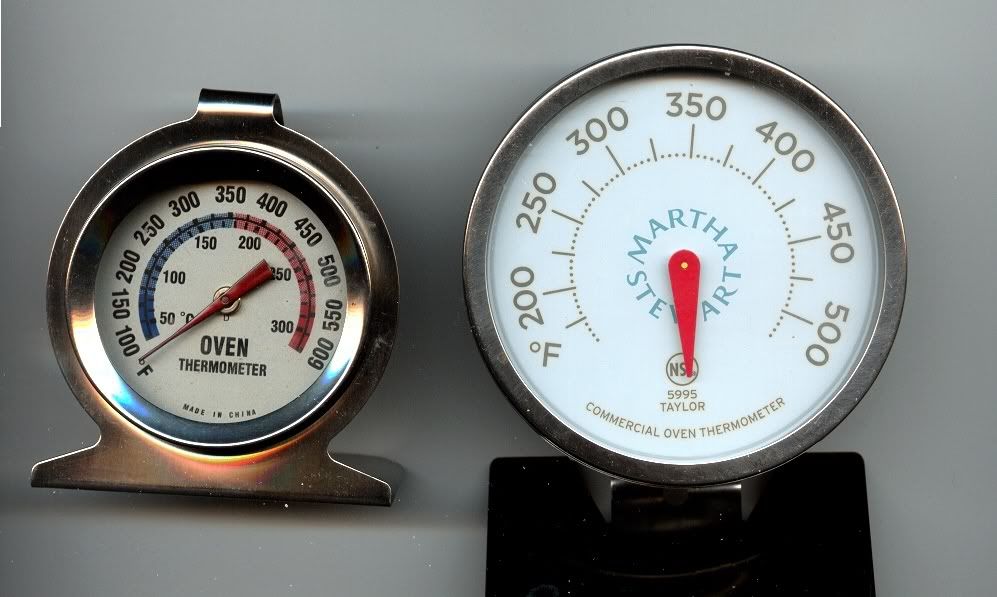
Of the oven thermometers sold in the US, I wonder how many are bought by people who intend to use the Celsius scale?
The two thermometers are shown below. The one I bought has the “advantage” of being able to be read in Celsius as well as Fahrenheit degrees. The one Joan bought reads only in Fahrenheit, but what an improvement in reading clarity.
Of the oven thermometers sold in the US, I wonder how many are bought by people who intend to use the Celsius scale?
quote:Originally posted by Pete Riegel:
We had an oven heating element burn out last week, and I replaced it. At that time we had a question concerning the accuracy of the temperature setting. I bought an oven thermometer at the hardware store. After using the one I bought, Joan bought a better one.
The two thermometers are shown below. The one I bought has the “advantage” of being able to be read in Celsius as well as Fahrenheit degrees. The one Joan bought reads only in Fahrenheit, but what an improvement in reading clarity.
Of the oven thermometers sold in the US, I wonder how many are bought by people who intend to use the Celsius scale?
So what did you conclude about the accuracy? Did all 3 thermometers agree?
It is interesting to note that the degree Celsius temperature is very close to half the Fahrenheit. So close that when one converts, all one needs do is multiply or divide by 2.
I would disagree that the bigger one is better. The needle seems to be so large it may cover over three of the marks and you would have to squint to see which of the small larks is intended.
One thing to look for when buying such a device is the stated accuracy. What is the tolerance on both units? Was it stated on the package? If it wasn't, then both may be very far off.
Those who use the degree Celsius scale are most likely to be professional chefs. They are also most likely to sneer at those who cook using cups and spoons instead of using mass and balances to measure out precise amounts in grams.
Maybe this is the advantage a professional chef has over a housewife. Their food tastes better because they use precise measurements and housewives use imprecise cups and spoons.
A couple of comments:
Joan's is a Martha Stewart brand, so "that's a good thing."
On the other hand, yours reads to 600F - reminds me of the amplifiers used by "Spinal Tap": "But this one goes to 11."
Joan's is a Martha Stewart brand, so "that's a good thing."
On the other hand, yours reads to 600F - reminds me of the amplifiers used by "Spinal Tap": "But this one goes to 11."
As for gauge accuracy, the two seem to agree pretty well. I haven't really tried an accurate comparison.
The stove control seems to produce an oven temperature about 40F higher than indicated by the two thermometers at a 350F set point. This has likely been going on as long as we have had the stove - 42 years.
Maybe it's time for a new thermostatic sensing element? On the other hand, Joan's been producing fine meals without a fix.
I think chefs produce more uniform food quality than housewives because of practice, not adherence to exact spice measurements. When you have to make the same meal 20 to 50 times a day you are bound to get into a groove that gets it right.
I used to listen to a Canadian radio station that would report the temperature in both F and C. They would say "It's 32, or 0." One day on the way to work they said "It's 12, or -12." Well make up your mind, which is it?
quote:I would disagree that the bigger one is better. The needle seems to be so large it may cover over three of the marks and you would have to squint to see which of the small larks is intended.
Maybe they are intentionally obscuring insignificant digits.
Pete, we had the opposite problem on a stove we had - the actual oven temp was about 25F lower than the set point, so food always took longer to bake.
I discovered that on the back of the set dial was an adjustment that rotated the dial face relative to the shaft, allowing one to make the set temperature higher or lower.
Of course, now we've got one of those fancy digital stoves, so we've got no worries - or do we?
I discovered that on the back of the set dial was an adjustment that rotated the dial face relative to the shaft, allowing one to make the set temperature higher or lower.
Of course, now we've got one of those fancy digital stoves, so we've got no worries - or do we?
Jim,
I am dazzled by your genius! I looked, and our stove knob has a bunch of adjustment grooves on the back side. I've made an adjustment and will report how things work out.
Many thanks.
I am dazzled by your genius! I looked, and our stove knob has a bunch of adjustment grooves on the back side. I've made an adjustment and will report how things work out.
Many thanks.
I adjusted the oven control knob 40 degrees in what I hoped was the right direction. I set both thermometers on the rack in the middle of the oven. I set the oven temperature control at 350F.
I switched on the oven, beginning the timing. The red light came on, indicating that the heating element was on. When the red light went off, I recorded time and temperature. I recorded time and temperature each time the red light went on or off. After a while the oven reached temperature equilibrium and I terminated the exercise.
I noted that the “made in China” thermometer indicated a temperature 25 F higher than did the Martha Stewart. I used the Martha Stewart to obtain the readings.
In the graph below you can see what happened. When the readings are close together, this indicates a period when the heating element was “on.” When the element was “off” the readings become more separated.
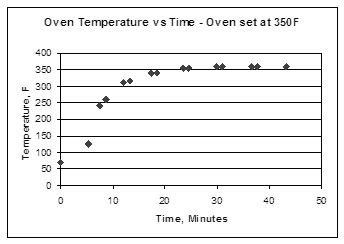
I switched on the oven, beginning the timing. The red light came on, indicating that the heating element was on. When the red light went off, I recorded time and temperature. I recorded time and temperature each time the red light went on or off. After a while the oven reached temperature equilibrium and I terminated the exercise.
I noted that the “made in China” thermometer indicated a temperature 25 F higher than did the Martha Stewart. I used the Martha Stewart to obtain the readings.
In the graph below you can see what happened. When the readings are close together, this indicates a period when the heating element was “on.” When the element was “off” the readings become more separated.
quote:Originally posted by Mark Neal:quote:I would disagree that the bigger one is better. The needle seems to be so large it may cover over three of the marks and you would have to squint to see which of the small larks is intended.
Maybe they are intentionally obscuring insignificant digits.
Then why have all the insignificant little marks? Only mark was needed.
quote:Originally posted by Jim Gerweck:
Pete, we had the opposite problem on a stove we had - the actual oven temp was about 25F lower than the set point, so food always took longer to bake.
I discovered that on the back of the set dial was an adjustment that rotated the dial face relative to the shaft, allowing one to make the set temperature higher or lower.
Of course, now we've got one of those fancy digital stoves, so we've got no worries - or do we?
Digital stoves should be switchable to degrees Celsius. In fact all electronic temperature devices internally measure in degrees Celsius. If it has Fahrenheit capability it is only via a conversion.
Is Pete's Chinese thermometer "internally measuring" in degrees Celsius or degrees Fahrenheit?
Both are available only via a conversion, and the same is true with electronic temperature devices.
Both are available only via a conversion, and the same is true with electronic temperature devices.
I do believe that both his gauges are mechanical bi-metal devices which rely on the difference in expansion rate between two different metals.
The modern electric stove controls it's temp through a thermostat that is commonly controlled by a thermocouple. A thermocouple is also two bits of dissimilar metal, but instead of relying on the variation in physical expansion it works on the variation in voltage produced by the joint, or electrical resistance of the joint.
Your electronic temperature sensor can go bad over time due to corrosion in the connectors at the joints and thermal fatigue in the metal.
Although it is tempting to believe a digital system because it has nice glowing definitive digits the only thing that makes it more accurate than your grandmothers stove is that it is newer.
Since there is no requirement for stove temps to be calibrated before or after installation, if you want to bake the perfect sponge cake it pays to check your temp reading with a secondary gauge.
How do you know if your secondary gauge is correct? Get a good secondary gauge, like this one:
Taylor Professional Fold-up Oven Test Thermometer
The point of setting the temp gauge on the stove is to try to cook the food for the right amount of time. If you are cooking meat, (not a cake), there is a better method of cooking than guessing by approximate temp and time. See here:
Pyrex Digital Probe Oven Thermometer/ Timer
This is an expensive one, you can get them as cheep as $20. This is a direct measurement device that eliminates most of the errors we induce.
If you want to know the temp in the oven and the temp in the food at the same time then they do make dual probe systems.
Taylor Digital Dual Prober Thermometer/Timer
For more accuracy you may want to calibrated against a thermometer that has been certified by the National Institute of Standards and Technology, but they are very expensive. A little cheaper is one that has been checked against one that has been certified - sort of second generation - friend of a friend certification, like this.
Certified Thermometers ( I would recommend the alcohol version over the mercury.)
Check you have the space inside your stove for the 145mm length. Because of it's length it should be readable to 1 or 2C. With one of these you could start a stove calibration service. Just print up some cards and let your wife sell your services to her friends who blame their ovens for their fallen sponges.
quote:Originally posted by JamesM:
I do believe that both his gauges are mechanical bi-metal devices which rely on the difference in expansion rate between two different metals.
The modern electric stove controls it's temp through a thermostat that is commonly controlled by a thermocouple. A thermocouple is also two bits of dissimilar metal, but instead of relying on the variation in physical expansion it works on the variation in voltage produced by the joint, or electrical resistance of the joint.
Yes, this is correct. In addition, these thermocouples are calibrated to produce a precise number of millivolts per degree Celsius temperature. Thus the systems designed to work with these probes do so internally in metric. with programming, you make it display any units you can create.
quote:Your electronic temperature sensor can go bad over time due to corrosion in the connectors at the joints and thermal fatigue in the metal.
This is why in industry and the market it is required to have your measuring devices checked and calibrated on a regular basis. Nothing keeps its accuracy over time. However, there is no prevision for home products to be maintained in such a fashion.
quote:Although it is tempting to believe a digital system because it has nice glowing definitive digits the only thing that makes it more accurate than your grandmothers stove is that it is newer.
That depends on the manufacturers statements of precision/accuracy and resolution. Of course for most consumer products accuracy is not as important as industrial products.
One thing that should be noted is that resolution, meaning the number of digits shown does not imply accuracy. A two digit device to the right of the decimal point can be more accurate then one showing 3 digits. It all depends on the design of the device and the precision to which it was calibrated.
quote:Since there is no requirement for stove temps to be calibrated before or after installation, if you want to bake the perfect sponge cake it pays to check your temp reading with a secondary gauge.
How do you know if your secondary gauge is correct?
Before buying any gauge you need to research the unit by checking for the stated accuracy. Is it +/- 5 %, 2 %, 1 % , 0.5 %? If it isn't stated, chances are the accuracy is very, very poor.
quote:For more accuracy you may want to calibrated against a thermometer that has been certified by the National Institute of Standards and Technology, but they are very expensive. A little cheaper is one that has been checked against one that has been certified - sort of second generation - friend of a friend certification, like this.
Certified Thermometers ( I would recommend the alcohol version over the mercury.)
Check you have the space inside your stove for the 145mm length. Because of it's length it should be readable to 1 or 2C. With one of these you could start a stove calibration service. Just print up some cards and let your wife sell your services to her friends who blame their ovens for their fallen sponges.
Even if you do get one that is calibrated to a NIST standard, it will need to be checked every year or so if the accuracy is to be guaranteed.
quote:Originally posted by Pete Riegel:
Is there nothing you won't make a graph for?
